
Soil biology • long-term fertility
Biochar & Cation Exchange Capacity (CEC)
Learn all the ways biochar increases the nutrient holding capacity of your soil and builds lasting fertility in your garden!
Biochar basics
Cation Exchange Capacity (CEC)
Cation (CAT’ eye on) Exchange Capacity is the measurement of the maximum plant-available nutrition your soil can hold. The higher the CEC, the more it can hold. Think of your soil as a sponge that can only hold a finite amount of air, water, and nutrients.
Anything beyond that amount leaches out of your soil into the groundwater below!
Plant-available nutrients ARE NOT at all stable in the soil. Because they’re water-soluble, they leach out very quickly!
With a low CEC, even when you put more in, your soil can’t hold any more, and they leach away…
A total waste of time, compost, and money!
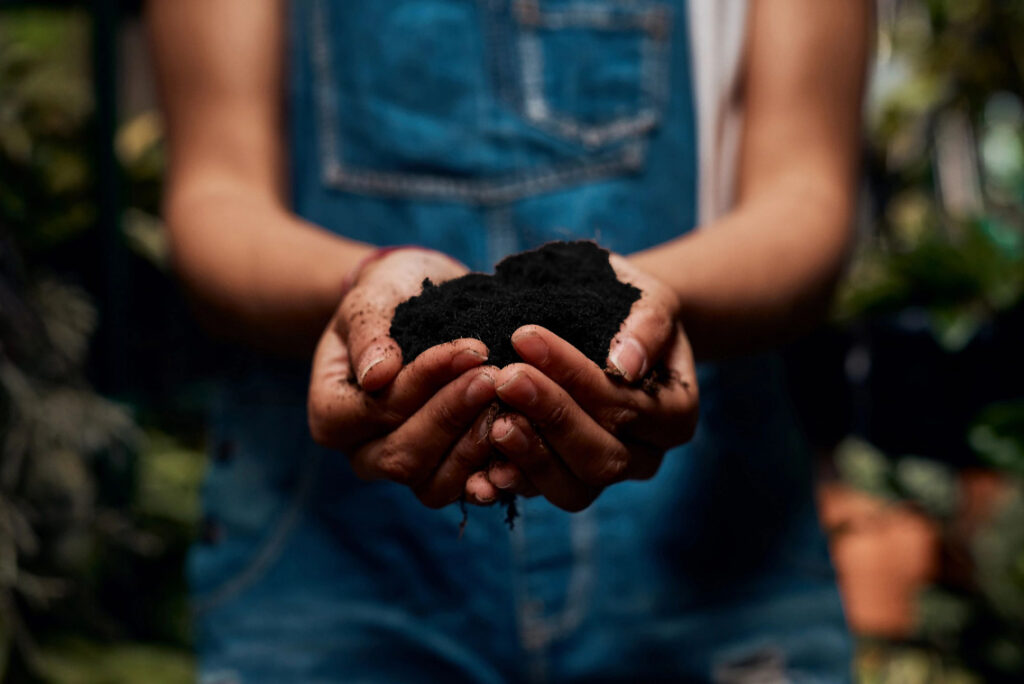
What if you could DO something to make your soil hold MORE nutrients? How valuable would that be?
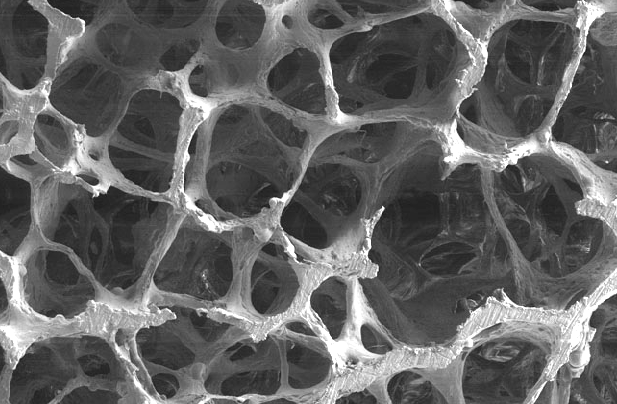
We’ve learned that biochar’s POROUS STRUCTURE makes it an ideal home for all the microorganisms needed in a healthy living soil!
But biochar also acts as a permanent magnet for ATTRACTING plant-available nutrients, and its porous structure holds them so they CAN’T leach away!
It’s a permanent magnet that never loses its strength… even for hundreds of years!
So the plant-available nutrients, and the microorganisms that make them available (in coordination with plant photosynthates), are there precisely in the root zone READY to be taken up by your plants!
A perfect example of this is soil nitrogen. It’s the most important nutrient for your plants.
Most of it is in the form of Ammonium, a STABLE but unusable form for your plants. Certain bacteria, known as Nitrifying Bacteria, convert Ammonium into Nitrate. This is the only form your plants can use.
The reason biochar is important is that nitrate is water-soluble and leaches from the root zone quickly. Biochar acts like a magnet, holding the nitrate in a loose ionic bond, strong enough to prevent leaching. However, it’s a weak enough bond that your plants can break to access and utilize it.
There are times when your plants need large amounts of nitrates and other times not so much. If your plant is indicating by its exudates that it already has sufficient nitrates, that nutrient will stay happily locked up by the biochar. And this goes for all the other “easily leached out” plant-available nutrients in your soil as well!
ALL plant-available nutrients are easily leached out…
Unless you have something to capture them! THIS is what the cation exchange capacity (CEC) measures!
When you add biochar, you’re not just guessing that your soil can hold more nutrients. CEC is one of the standard tests that can be measured at any agricultural testing lab.
It’s also measured through microscopy when you see the abundant soil life on your computer screen.
But the only indicator that really matters is— how well your garden grows!
Biochar isn’t an amendment you must keep adding year after year. After you’ve achieved the 10-20% level in your top 20 inches (50cm) of soil, it’s a permanent nutrient magnet and microorganism condominium that never loses its strength… it just keeps on working!
It’s a really exciting concept when you finally understand the working complexity of it!
Here’s a review of how it works from our Soil Biology Page— Bacteria and fungi consume plant photosynthate, raw organic matter, and soil minerals, the first step of converting complex soil nutrients into plant-available forms. The bacteria and fungi must then be consumed by protozoa and nematodes before the nutrients finally become plant-available.
All the different trophic (food) levels are needed. One level of biology consumes the level BELOW it… and is subsequently consumed by the level ABOVE it.
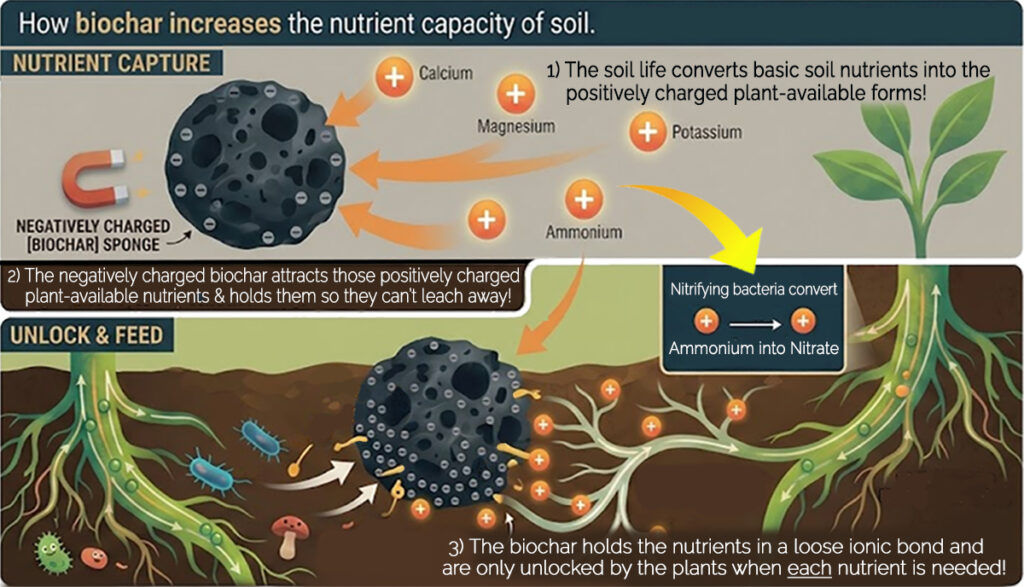
Here’s an image showing how Biochar plays a very important role in this: (Follow the 1, 2, & 3)
Think of biochar as a long-lasting soil microbe habitat with benefits when inoculated with compost & microbes!
Nutrient Capture
Your soil life converts soil minerals and compost into the positively charged and plant-available forms.
The negatively charged biochar attracts those positively charged plant-available nutrients so they can’t leach away.
Unlock & Feed
The nutrients are held in a loose ionic bond with the biochar, but giving the roots access to unlock each nutrient as needed.
Prevents the Wasteful and Costly Leaching of Nutrients
Without Biochar— Many of the nutrients converted to the soluble plant-available forms by your soil biology will be leached out of your soil as there’s nothing to capture and hold them.
With Biochar— Any plant-available nutrients in excess of what’s needed immediately by your plants are stored for future use and for the second crop in your succession planting.
Biochar FAQ
Quick answers to the questions gardeners ask most.
Do I need to charge biochar?
Yes— Charging fills its pores with nutrients and biology so the biochar feeds your biology instead of (uncharged biochar) temporarily tying up available nutrients.
Can I add biochar directly to beds?
You can, but it’s best mixed with compost or another nutrient source first. If you apply it raw, keep the rate low and place it only ON TOP of the soil without mixing.
Will biochar change my soil pH?
It can, depending on the feedstock and how it was made. If you’re unsure, test a small area first and keep an eye on pH-sensitive crops.
How much should I use?
Start with small amounts of charged biochar blended into compost or potting mixes. Build gradually over seasons as you learn how your soil responds.
Is Biochar the same as charcoal briquettes?
No. Briquettes contain binders and additives. Use clean, additive-free biochar intended for soil use. You CAN use charcoal produced for grilling if it has NO binders or additives (i.e., lighter fluid) like some of the products in the Red Oak brand.
Just crush it into small pieces about the size of a coin, charge it, and add it to your soil. Just one caveat— it probably wasn’t made at the ideal 1500°F temp, so there might still be some impurities in it!
Does biochar replace compost?
No—compost brings nutrients and living biology. Biochar is a long-term structure and habitat that works best alongside compost and mulch.
Keep learning
Building long-term fertility with biochar-best practices
Want step-by-step demos on making, charging, and applying biochar—plus composting and soil microscopy? Follow along with us on YouTube and start improving your soil this season.